1N4007 vs. UF4007 vs. 1N5819: Which Diode Goes Where?
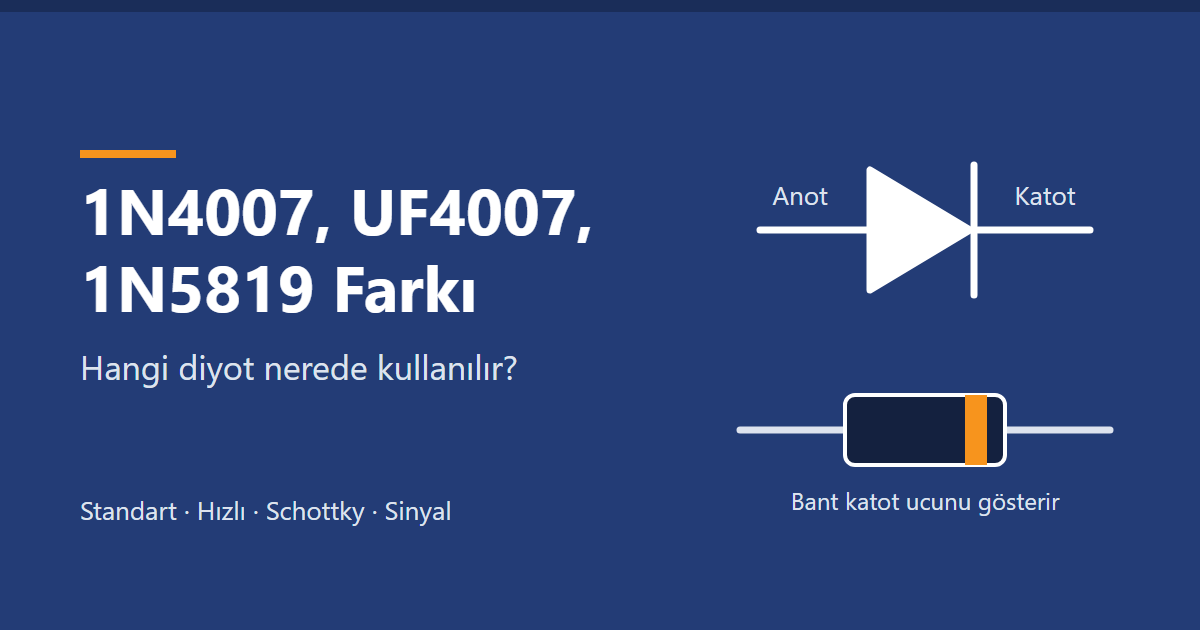
The 1N4007 is a standard rectifier diode rated for 1000 V and used for 50 Hz mains rectification. The UF4007 is the fast-recovery version of the same voltage and current class and is preferred in switch-mode power supplies. The 1N5819 is a 40 V Schottky diode: its forward voltage drop is about half that of the 1N4007, but it cannot withstand high voltage. All three are 1 A parts in the same DO-41 package, so they fit the board physically, but electrically they are not always interchangeable.
This article answers the question most often asked at the repair bench: can the diode in my hand replace the failed diode on the board? The answer depends on three parameters: reverse voltage rating, reverse recovery time and forward voltage drop. We have also added the small-signal diode 1N4148 to the comparison, because although it looks different, it is part of the same confusion.
Diode types: four kinds, four different jobs
A diode conducts current from anode to cathode and blocks it in the reverse direction. What separates the types is the voltage at which they do this, how fast, and with how much loss.
- Standard rectifier diode (1N4007): Withstands high reverse voltage and turns off slowly. Intended for rectification at mains frequency.
- Fast-recovery diode (UF4007): Its structure is similar to a standard diode, but it goes from conduction to cutoff in tens of nanoseconds. In exchange, its forward voltage drop is higher.
- Schottky diode (1N5819): Formed by a metal-semiconductor junction. Its forward voltage drop is low and it switches fast; its reverse voltage rating is low and its reverse leakage current is high.
- Signal diode (1N4148): A very low-capacitance, very fast, low-current diode. It does not carry power; it works in signal and logic circuits.
Comparison table: 1N4007, UF4007, 1N5819, 1N4148W
The values below are taken from the datasheets linked at the end of the article. The same part number may be specified with small differences by different manufacturers; make a habit of checking the datasheet of your own part.
| Parameter | 1N4007 | UF4007 | 1N5819 | 1N4148W |
|---|---|---|---|---|
| Type | Standard rectifier | Ultra-fast recovery | Schottky | Signal (fast switching) |
| Repetitive peak reverse voltage (VRRM) | 1000 V | 1000 V | 40 V | 100 V |
| Forward current | 1 A (average) | 1 A (average) | 1 A (average) | 300 mA (continuous) |
| Maximum forward voltage (VF) | 1.1 V (1 A) | 1.7 V (1 A) | 0.6 V (1 A) | 1.25 V (150 mA) |
| Reverse recovery time (trr) | Not specified | Max 70 ns | Not specified | Max 4 ns |
| Maximum reverse leakage current (25 °C) | 5 µA (1000 V) | 10 µA (1000 V) | 1 mA (40 V) | 1 µA (75 V) |
| Capacitance | 13 pF (typical, 4 V) | 15 pF (typical, 4 V) | 110 pF (typical, 4 V) | Max 2 pF (0 V) |
| Non-repetitive surge current (IFSM) | 30 A (8.3 ms) | 30 A (8.3 ms) | 25 A (8.3 ms) | 1 A (1 s) |
| Maximum junction temperature | 150 °C | 150 °C | 125 °C | 150 °C |
| Package | DO-41 | DO-41 | DO-41 | SOD-123 (SMD) |
Parts in the table: 1N4007, UF4007, 1N5819 and 1N4148W-7-F. On all four diodes, the band on the body marks the cathode.
Why does reverse recovery time (trr) matter?
Reverse recovery time is the time a conducting diode needs to stop the current once the voltage across it reverses. During this time the diode also conducts in the reverse direction. In other words, for a brief moment it does not behave like a diode but becomes a path close to a short circuit.
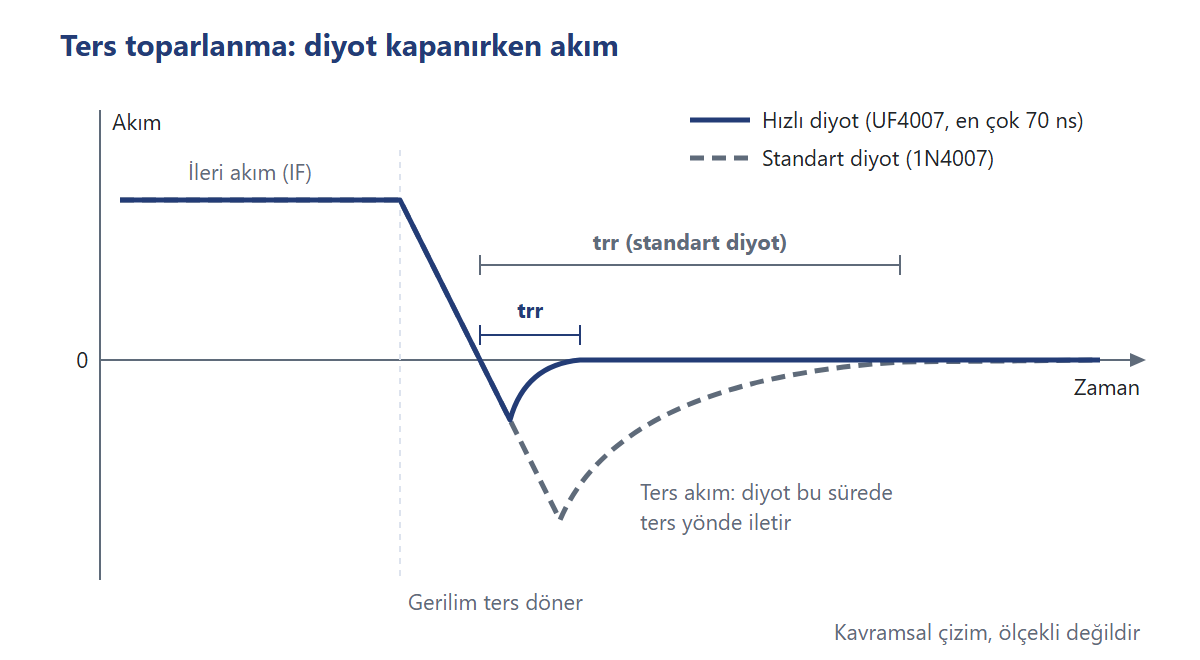
On a 50 Hz mains supply, one period lasts 20 ms. On this scale the share of recovery time is negligible, and the 1N4007 does its job without trouble. The 1N4007 datasheet does not give a trr value at all; standard-recovery rectifiers are not designed for this purpose and turn off much more slowly than fast diodes.
In a switch-mode power supply, the situation changes. At 100 kHz, one period is 10 µs. The UF4007’s maximum recovery time of 70 ns is 0.7 percent of this period. A slow diode, on the other hand, conducts reverse current in every period; this current heats both the diode and the switching transistor.
In Schottky diodes, conduction occurs through a different mechanism, so instead of trr the 1N5819 datasheet lists a fast-switching characteristic and the junction capacitance (typ. 110 pF).
Which diode goes where?
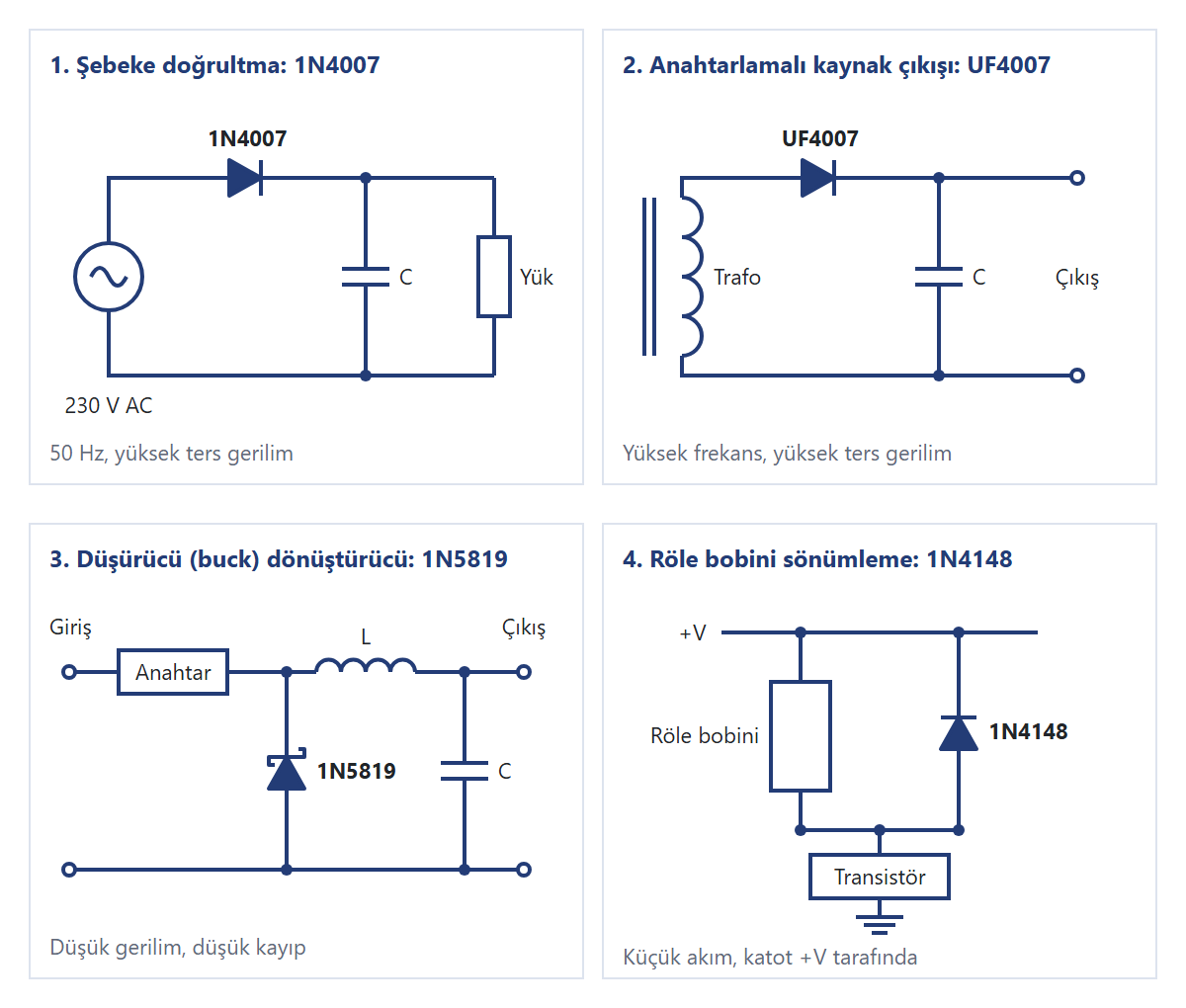
1N4007: mains rectification
The peak value of 230 V mains is 230 × 1.414 ≈ 325 V. In a capacitor-filtered half-wave rectifier, during the reverse half-cycle the diode sees the sum of the mains peak voltage and the charged capacitor: about 650 V. That is why the 1N4007’s 1000 V rating leaves a safe margin. The 400 V member of the same family, the 1N4004, falls short in this circuit. The datasheet also requires the current to be derated by 20 percent with a capacitive load; in this capacitor-filtered circuit the limit for the 1N4007 becomes 0.8 A.
UF4007: high frequency and high voltage
High-voltage output rectifiers of switch-mode supplies and snubber circuits on the transformer primary need both high reverse voltage and speed. The UF4007 meets both requirements at once.
1N5819: low voltage, low loss
In step-down (buck) converters, the freewheeling diode carries the inductor current while the switch is off (the time during which it does not conduct). The reverse voltage the diode sees equals the input voltage. In circuits with 12 V and 24 V inputs, the 1N5819’s 40 V rating is sufficient, and the low VF translates directly into efficiency. For the same reason it is chosen for reverse polarity protection and at the input of a linear regulator.
1N4148: signals and small coils
Used with logic-level signals, in clipping circuits and for suppressing small relay coils. The coil current must be below the diode’s current limit: the 1N4148W carries 300 mA continuously.
Example calculation: how hot does a diode get?
The power loss across a conducting diode is the product of its forward voltage drop and the current: P = VF × IF. With the maximum VF values from the datasheets, the results for 1 A are:
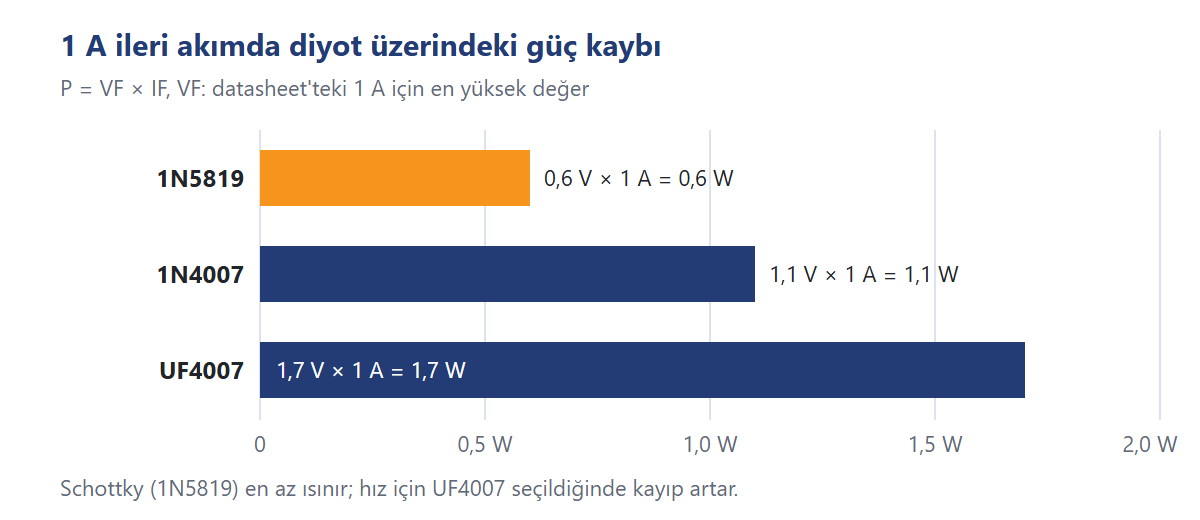
- 1N5819: 0.6 V × 1 A = 0.6 W
- 1N4007: 1.1 V × 1 A = 1.1 W
- UF4007: 1.7 V × 1 A = 1.7 W
For a rough idea of the temperature rise, multiply this power by the typical thermal resistance in the datasheet. For the 1N5819, 0.6 W × 50 °C/W gives a 30 °C rise. For the UF4007, 1.7 W × 60 °C/W = 102 °C; at 25 °C ambient the junction approaches 127 °C, leaving little margin to the 150 °C limit. This is a rough estimate: thermal resistance values are given for specific copper areas, and if the copper on the board is small, the rise will be even higher. The result shows that a diode should not be run continuously at its 1 A limit.
The price of a Schottky diode is reverse leakage current. At 40 V reverse voltage, the 1N5819 leaks at most 1 mA at 25 °C and at most 10 mA at 100 °C. In the second case, the loss from leakage current alone is 40 V × 10 mA = 0.4 W. For the 1N4007, the leakage current at the same temperature is at most 50 µA.
Substitution rules
| Diode on the board | Replacement diode | Does it work? | Why |
|---|---|---|---|
| 1N4007 | UF4007 | Usually yes | Same voltage, current and package. Because VF is higher, it runs hotter at currents close to 1 A. |
| UF4007 | 1N4007 | Not at high frequency | In a switching circuit it turns off slowly, heats up and can damage the circuit. No problem in 50 Hz rectification. |
| 1N4007 | 1N5819 | Only at low voltage | In any circuit where the reverse voltage exceeds 40 V, the 1N5819 breaks down. |
| 1N5819 | 1N4007 | Usually not | The voltage drop increases by about 0.5 V; in a switching circuit it is also too slow. |
| 1N4001…1N4006 | 1N4007 | Yes | Same current and VF, higher reverse voltage rating. |
| Power diode | 1N4148W | No | Continuous current limit is 300 mA; it cannot carry rectifier current. |
Measuring with a multimeter: how can you tell the type?
- Disconnect at least one lead of the diode from the board. Parallel components on the board will skew the measurement.
- Set the multimeter to diode mode. Touch the red probe to the anode and the black probe to the cathode (the banded end).
- With silicon diodes (1N4007, UF4007, 1N4148), you will usually see a value between 0.5 and 0.7 V on the display. A Schottky diode reads noticeably lower, mostly between 0.15 and 0.3 V.
- Reverse the probes. On a good diode, the multimeter shows an open circuit.
- A value close to zero in both directions means a short circuit; an open circuit in both directions means the diode is open.
This measurement distinguishes a Schottky diode from a silicon diode, but it does not distinguish the 1N4007 from the UF4007. The difference between the two is speed, which a multimeter cannot see; you need to read the marking on the body. We explained how diode mode is used on other components in the MOSFET testing article.
Common mistakes
- Fitting a 1N4007 in a switch-mode supply. The supply appears to work, the diode and the switching element heat up, and the failure soon recurs.
- Fitting a Schottky diode on the mains side. A 40 V diode breaks down instantly at a 325 V peak voltage.
- Looking only at current. All three diodes are rated 1 A; the difference is determined by voltage, speed and loss.
- Forgetting leakage current. In battery-backed or very low-current circuits, the leakage current of a Schottky diode has to be taken into account as temperature rises.
- Fitting the diode backwards. The band is the cathode. On the board’s silkscreen, the line also marks the cathode.
Frequently asked questions
Can a UF4007 be used instead of a 1N4007?
Yes, in most circuits. Both are rated 1000 V and 1 A, and their packages are the same. Because the UF4007’s forward voltage at 1 A can reach 1.7 V, it runs hotter than the 1N4007 at high current.
What happens if a 1N4007 is fitted instead of a UF4007?
In a 50 Hz rectifier, there is no problem. In a high-frequency circuit such as a switch-mode power supply, the 1N4007 cannot turn off in time, conducts reverse current in every period and overheats.
Can a 1N4007 be used instead of a 1N5819?
It is not recommended. The forward voltage at 1 A is 1.1 V for the 1N4007 and 0.6 V for the 1N5819; the loss nearly doubles. In switching circuits such as a step-down converter, the 1N4007 is also too slow.
What is the difference between the 1N4001 and the 1N4007?
The difference is the reverse voltage rating: the 1N4001 is rated for 50 V, the 1N4007 for 1000 V. The average current (1 A) and maximum forward voltage (1.1 V) are the same across the whole family, which is why the 1N4007 can replace the other members of the family.
How can you identify a Schottky diode with a multimeter?
In diode mode, the forward reading is noticeably lower than for silicon diodes. A silicon diode usually shows 0.5 to 0.7 V, a Schottky diode mostly 0.15 to 0.3 V.
Conclusion
When replacing a diode, check three questions in order: is the reverse voltage in the circuit below the diode’s rating, does the circuit operate at mains frequency or at high frequency, and is the forward voltage drop acceptable in terms of heat or efficiency? The right starting point is the 1N4007 for mains rectification, the UF4007 at high-frequency, high-voltage nodes, the 1N5819 in efficiency-critical circuits below 40 V, and the 1N4148 for signal work. For other current and voltage classes, see the single rectifier diodes category.
References
Products in this article
-
 $0.33
1N4007
MIC Master Instr. Corp. · EE00205DIODE GEN PURP 1KV 1A DO41102 In Stock -
$0.04
UF4007
Hottech Semiconductor · EE01628-5DIODE GEN PURP 1KV 1A DO4120 In Stock -
$0.16
1N5819
MIC · EE01923-2DIODE SCHOTTKY 40V 1A DO4150 In Stock -
 $0.041
1N4148W-7-F
Diodes Incorporated · EE02027-5DIODE GEN PURP 100V 300MA SOD123RoHS compliant169 In Stock

More from Temel Elektronik
- Temel ElektronikIntermediate
What Is the 74HC595? Wiring Diagram and Driving LEDs
What is the 74HC595 and how do you wire it? Step by step: pinout, the SER, SCK and RCK signals, daisy-chaining, and resistor calculation…
- Temel ElektronikIntermediate
What Is a Zener Diode? Series Resistor Calculation and Reading the Code
What is a Zener diode and how does it work? Series resistor calculation, reading the voltage from 1N47xx and BZX55C codes, power selection and…
- Temel ElektronikBeginner
555 Timer IC: Astable Circuit and Frequency Calculation
How does the 555 timer work in astable mode? Pin functions, frequency and duty cycle formulas, example calculations and common mistakes when building the…